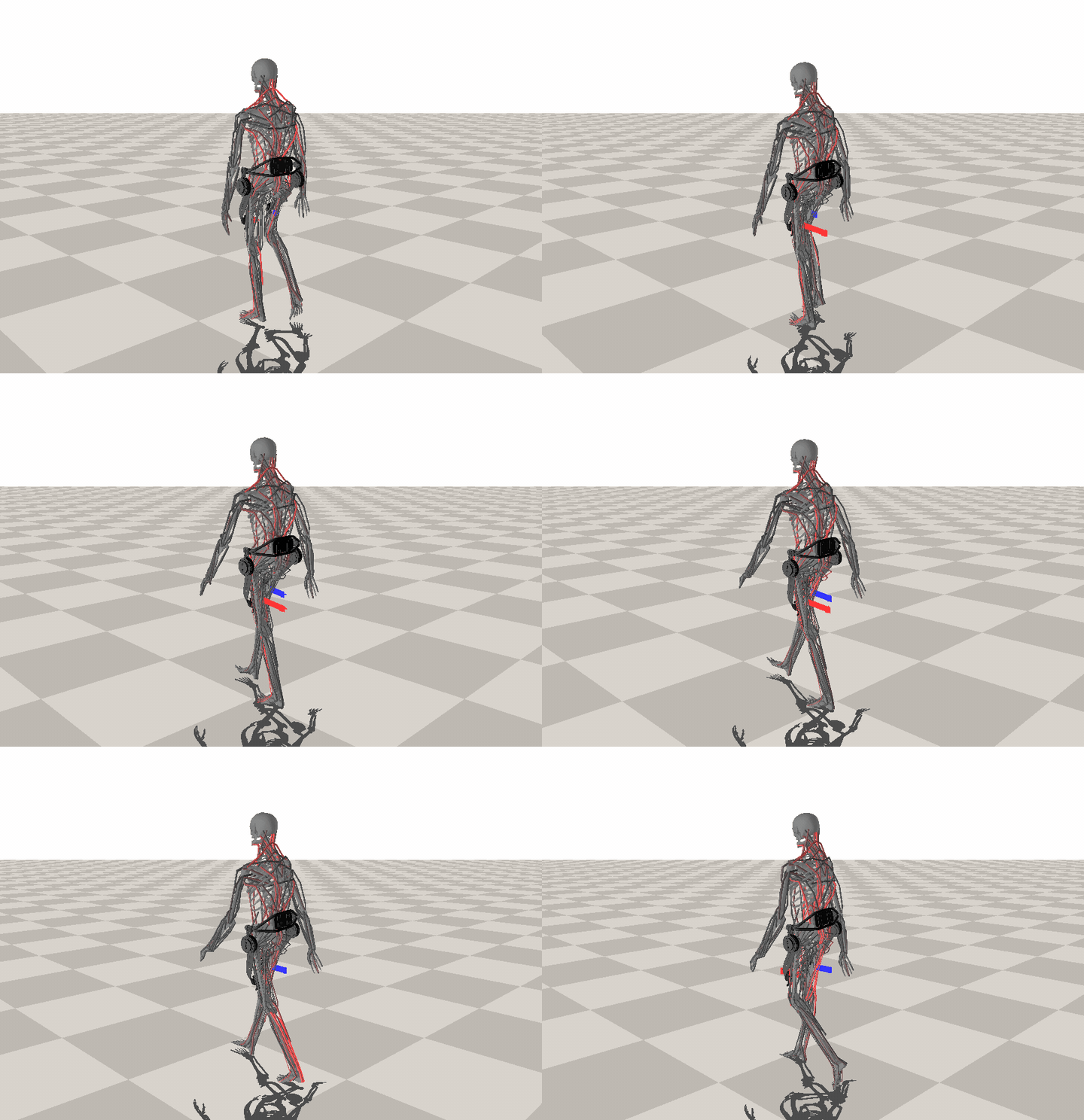
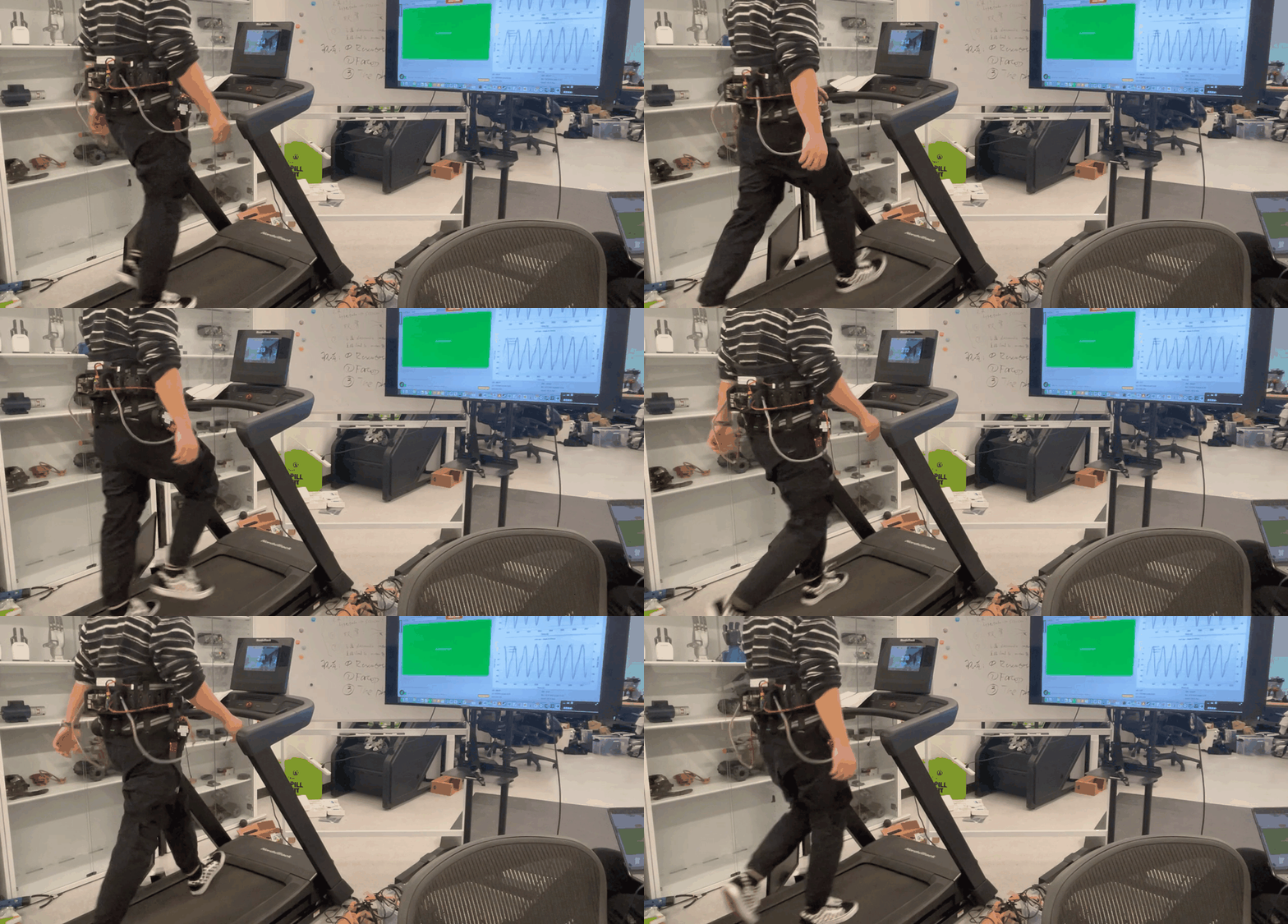
Prior-guided residual learning
A velocity-proportional prior supplies nominal assistance while the learned policy corrects timing and amplitude.
Learning progression
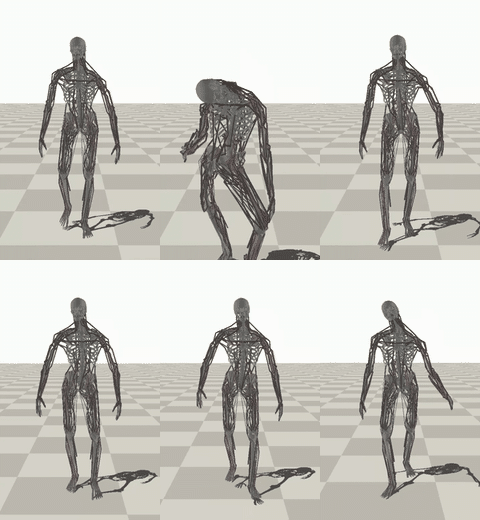
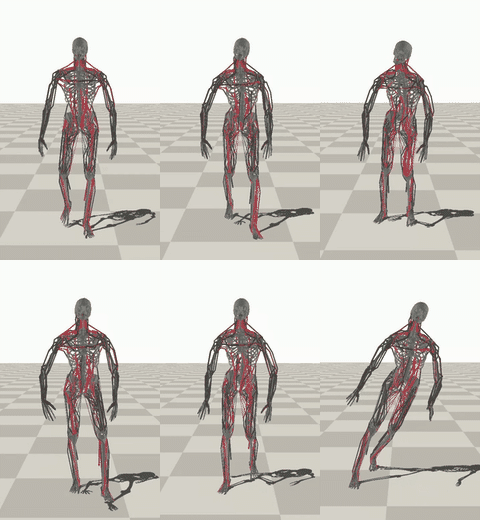
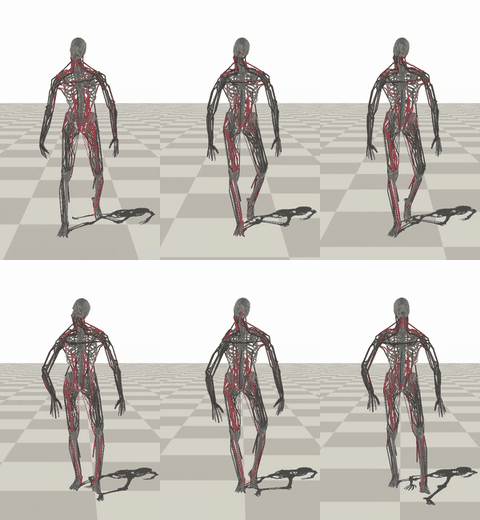
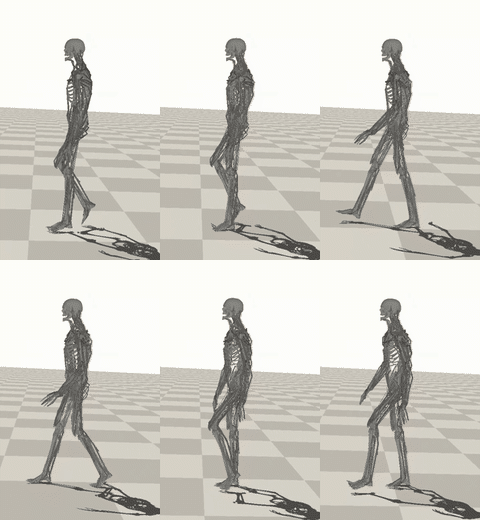
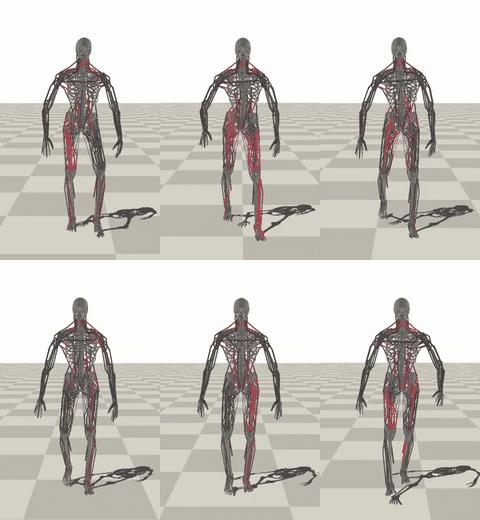
ResidualAssist combines a simple velocity-based torque prior with a reinforcement learning policy that learns state-dependent residual corrections.
Learning exoskeleton assistive torque directly through reinforcement learning remains challenging because assistance is highly phase-sensitive, whereas noisy biomechanical rewards provide indirect guidance for torque timing and amplitude. Rather than learning an entire torque profile from scratch, the proposed framework begins with an interpretable nominal assistance pattern and learns how to adjust it.
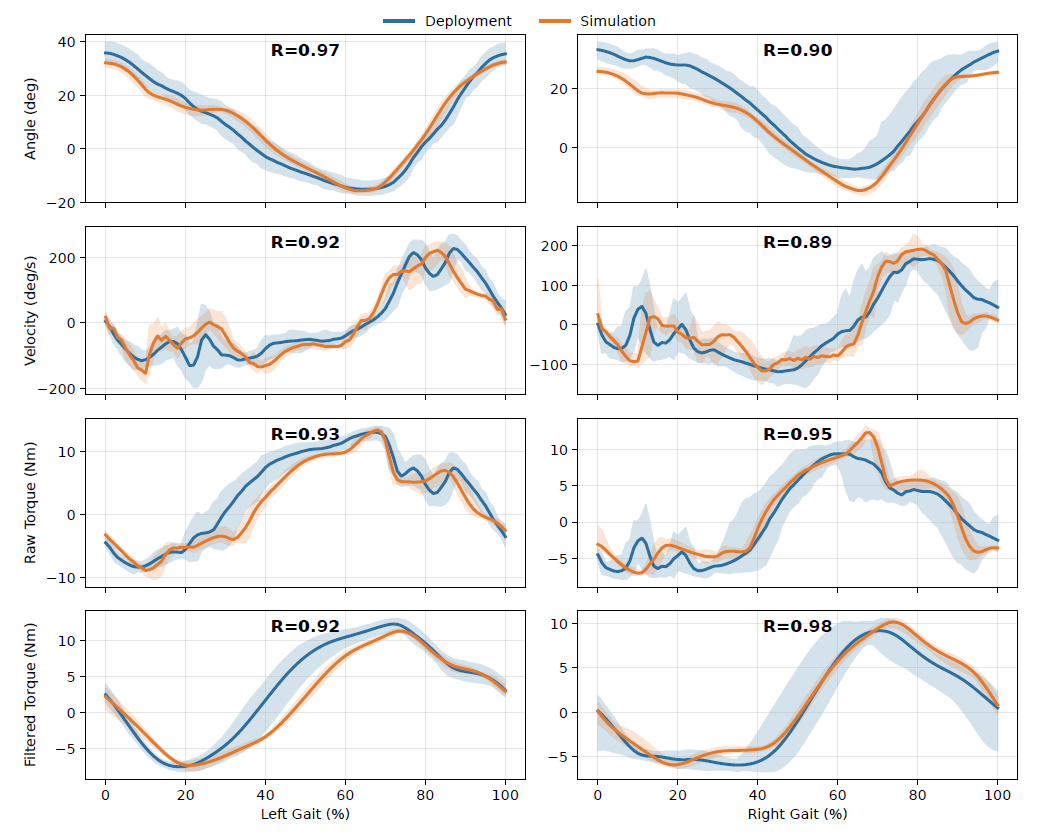
A parameter-shared, leg-decoupled policy generates bilateral torque from each leg’s local state. The study evaluates this structure in a unilateral-load-induced asymmetric gait condition, after simulation training and deployment on the physical device.
A velocity-proportional prior supplies nominal assistance while the learned policy corrects timing and amplitude.
The same actor processes each leg separately using only that leg’s local observation.
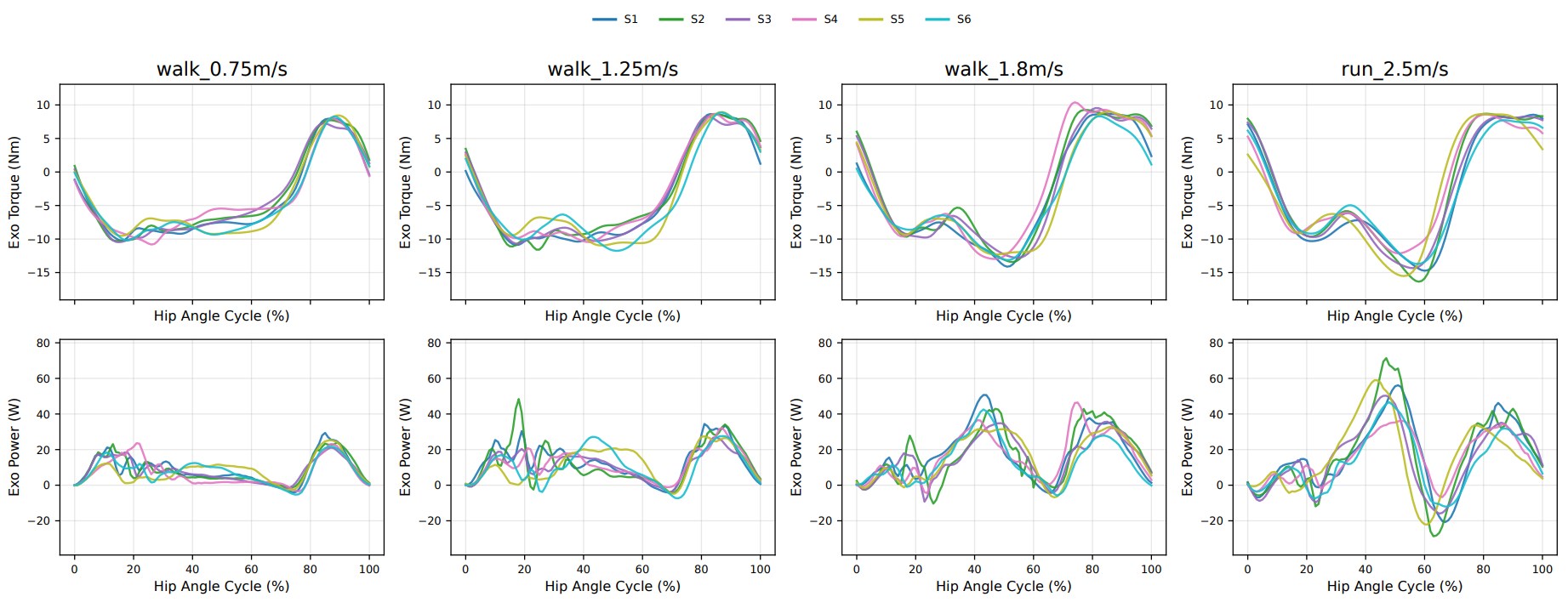
The controller is tested in walking, running, and a unilateral-load condition with six participants.
The training procedure separates the acquisition of natural, muscle-actuated locomotion from exoskeleton assistance learning.
The musculoskeletal human controller is trained through imitation learning to reproduce the reference gait before exoskeleton assistance is introduced. The resulting controller provides the starting point for the second training stage.
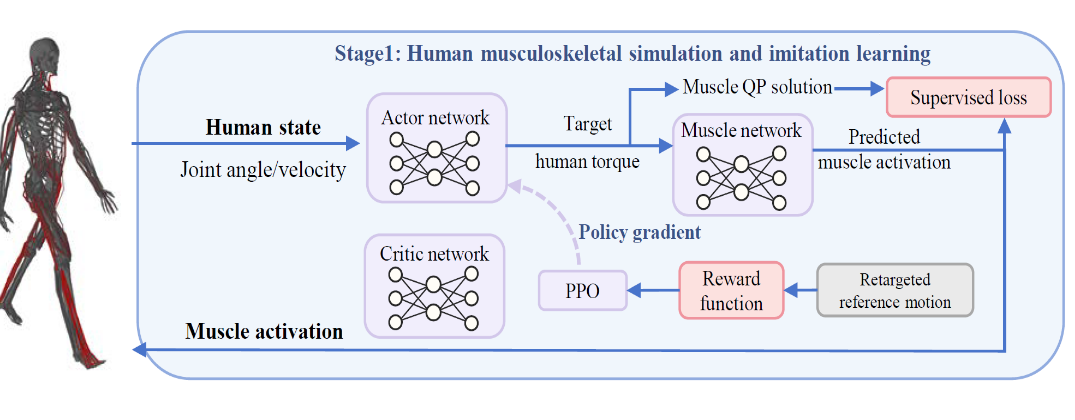
The pretrained human controller continues to update under the adaptation objective while the exoskeleton policy learns residual torque corrections around a velocity-based prior.
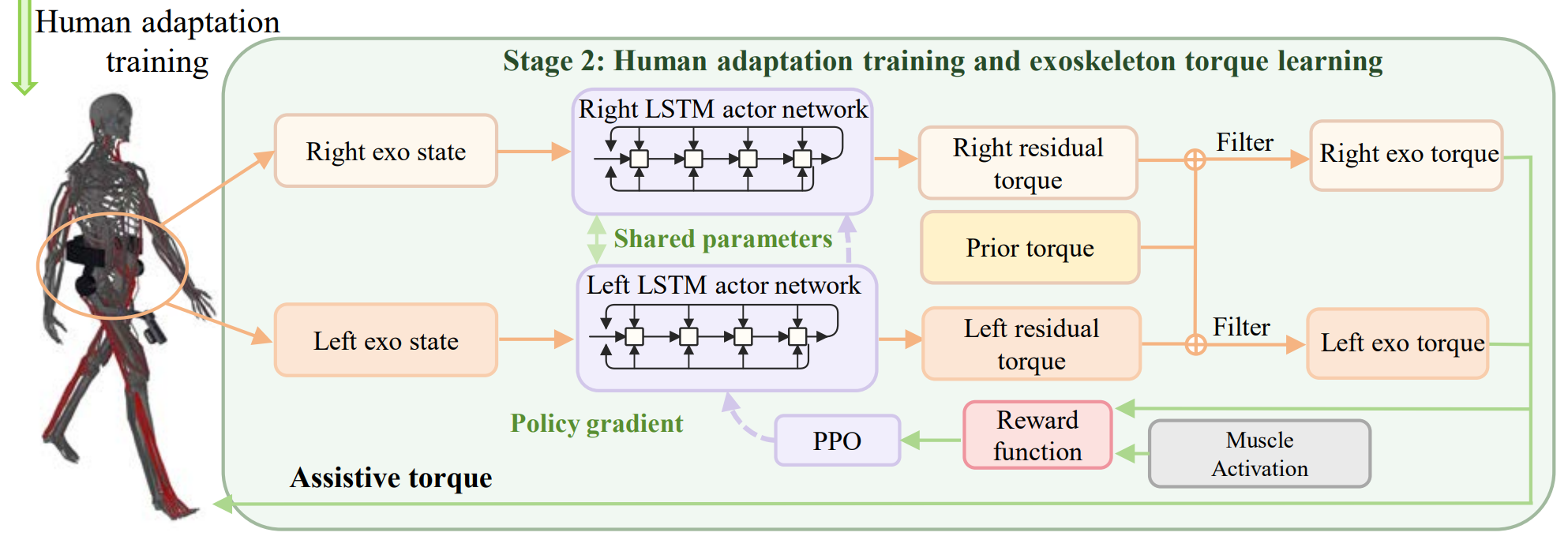
The prior maps filtered hip angular velocity to nominal assistive torque. A recurrent policy outputs a residual command, and the combined torque is clipped and low-pass filtered before it reaches the simulated or physical exoskeleton.
Both legs share actor parameters, while each torque command depends only on the corresponding leg’s local angle, velocity, and previous torque.
The first stage develops stable muscle-actuated locomotion before the exoskeleton policy is introduced.
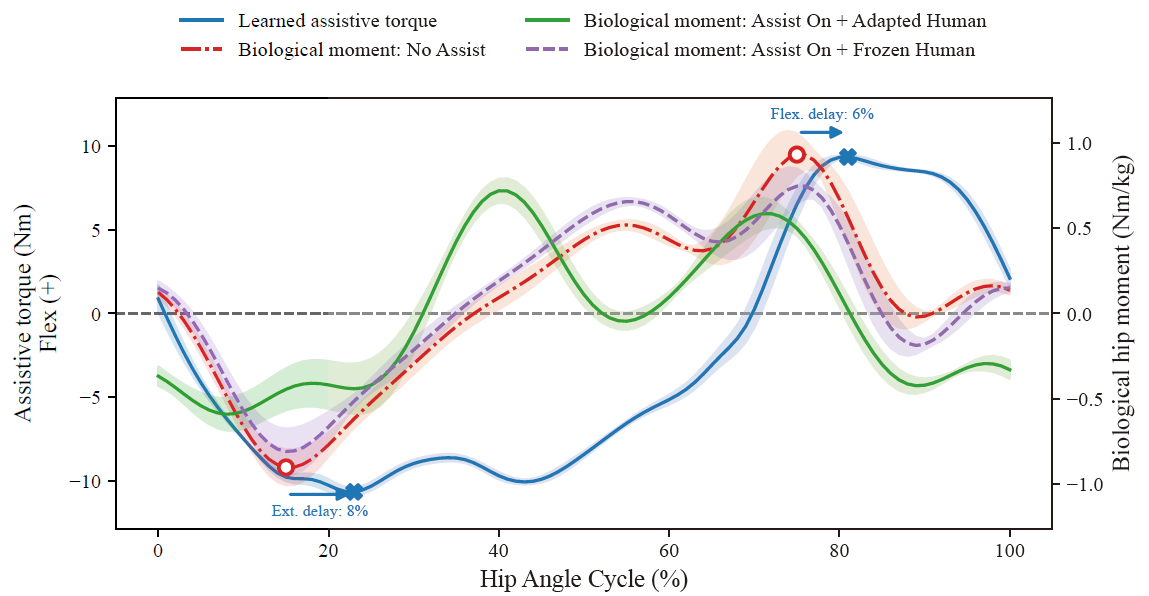
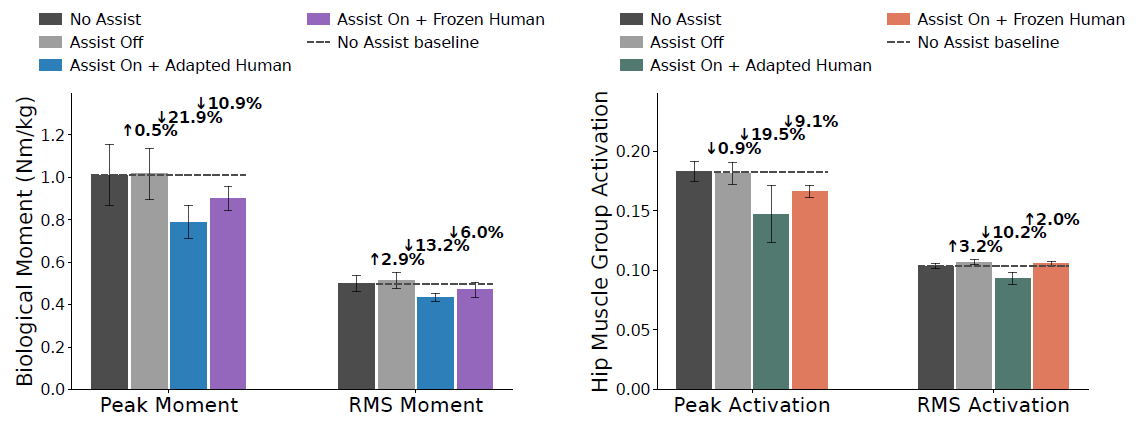
The reported reductions below refer to the simulation condition with active assistance and human adaptation, compared with the no-exoskeleton baseline.
The device uses a quasi-direct-drive hip exoskeleton, wearable IMUs, a Raspberry Pi 5, and a Teensy 4.1 control stack.
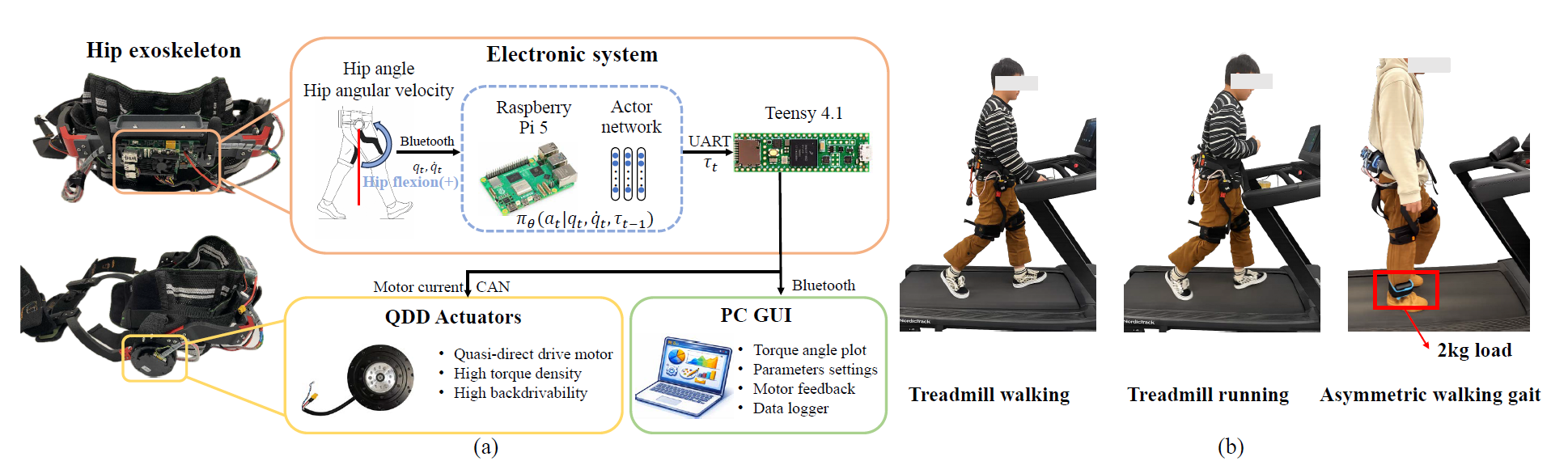
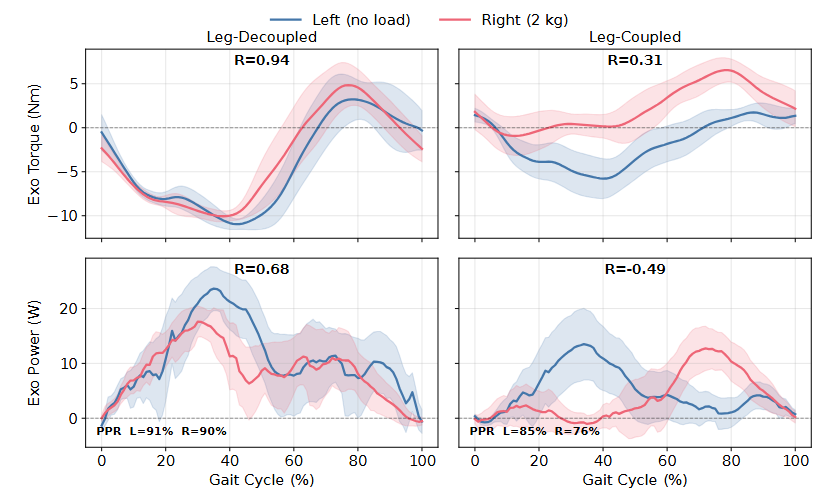
Under the tested 2 kg right-ankle load, the leg-decoupled controller produced more repeatable torque and power profiles across gait cycles than the leg-coupled controller.
Positive power ratio remained approximately 90% on both legs with leg-decoupled control, compared with 85% and 76% on the unloaded and loaded legs with leg-coupled control.
Scope. This controlled loading protocol does not represent pathological gait. The reported advantage is limited to the tested unilateral-load condition in healthy participants.
The complete eight-page manuscript is embedded below and can also be opened as a standalone PDF.
@article{residualassist2026,
  title = {ResidualAssist: Residual Reinforcement Learning in Simulation for
           Leg-Decoupled Exoskeleton Control in Walking, Running, and Asymmetric Gait},
  year  = {2026}
}